Listening to the discussion about rebooting for kernel updates reminded me of a site I worked at in the 1980s. We had three mainframes, and a rather fancy home-grown operating system that allowed tasks to be split across mainframes. Having an absolute requirement for continuous availability, we normally ran with two mainframes supporting the live system, and one held in reserve (the reserve one was often used standalone for running system testing). When manufacturer updates needed to be applied to one of the running machines, tasks would all be progressively switched on to one machine, then the spare machine spun up to join with the running one in supporting the live system, and tasks gradually spread out across two machines again, while the one that had been taken offline could be run standalone for applying updates.
It was quite mesmerising watching all the tape drives associated with the closing machine spinning down as tasks were transferred, then those belonging to the new machine rhythmically spinning up as tasks were moved onto it. From this and other unusual features of the OS (like being able to also run multiple incompatible manufacturers’ OSs within the locally-developed OS) I suspect it implemented some sort of distributed VM concept, but we weren’t encouraged to ask too many questions.
[I guess I should warn that this is pretty far off topic from the episode.]
I used to work as a backup operator for a mid-sited utility company, where is was my co-responsibility to do backups for the part of the business that dealt with incoming customer calls during emergency events. This was a once weekly backup, followed by 6 daily backups. A complete backup is done on the weekly, and then daily changes from the last weekly are recorded in the daily backups. A complete recovery from scratch might involve going back to the last weekly and then applying all subsequent daily backups as deltas.
Anyway, the weekly backup involved about 12 to 14 reel tapes. I would unpack them from the receiving box, document the numbers in a log, and then load all of them on my arm and head to the air conditioned and secured room with the raised floors and the halon fire suppression system with the big red warnings on the door to evacuate immediately if the halon system alarm activated. (The alarm did activate once, but I don’t think it deployed… but I didn’t stick around to find out! ) Each tape would take just under 30 minutes, so I got very good at scheduling my arrivals just as the tape was rewinding in time to load the next one, and interact with the terminal to tell it to proceed. I was a student marker for the undergrad COBOL course, so those 7 hour shifts every two weeks gave me lots of time to read and mark all those long assignment outputs
(even more tenuous association) I also worked somewhere which had a home-grown processing language called YBOL - to which the answer was “nobody knows”.
Also worked somewhere where the only (non-fire-) exit from the computer hall was through the IT department, so the weekly appearance of the guy carrying the offsite backup tapes on a hand-truck was a reassuring event.
I always wondered how that particular place got insurance for their computing setup, as it was in a city centre and the other side of the back wall of the computer hall was a petrol (gas) filling station.
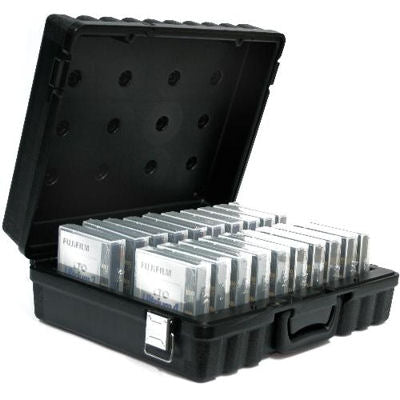
Yeah I can’t find a good picture of the type of box we used to use… blue, with metal protectors on all the eight corners and metal around the lid opening and latch. Eventually technology progressed, and they updated to LTO tapes (here’s a pic of some of them in a transport box https://nationalhardware.ca/cdn/shop/products/LTO20black_400x400.jpg ), but at that point everything would fit on one tape, so they decided the IT day staff could manage that and the student backup administrator co-roles were eliminated. Luckily for me, I had graduated by then and transitioned to a full time developer role, although in another location.
I didn’t see cartridge drives until much later, when I dipped into the world of minicomputers (ie freezer sized). These were the sort of tapes that were being wheeled around in my mainframe days.

 ) Each tape would take just under 30 minutes, so I got very good at scheduling my arrivals just as the tape was rewinding in time to load the next one, and interact with the terminal to tell it to proceed. I was a student marker for the undergrad COBOL course, so those 7 hour shifts every two weeks gave me lots of time to read and mark all those long assignment outputs